
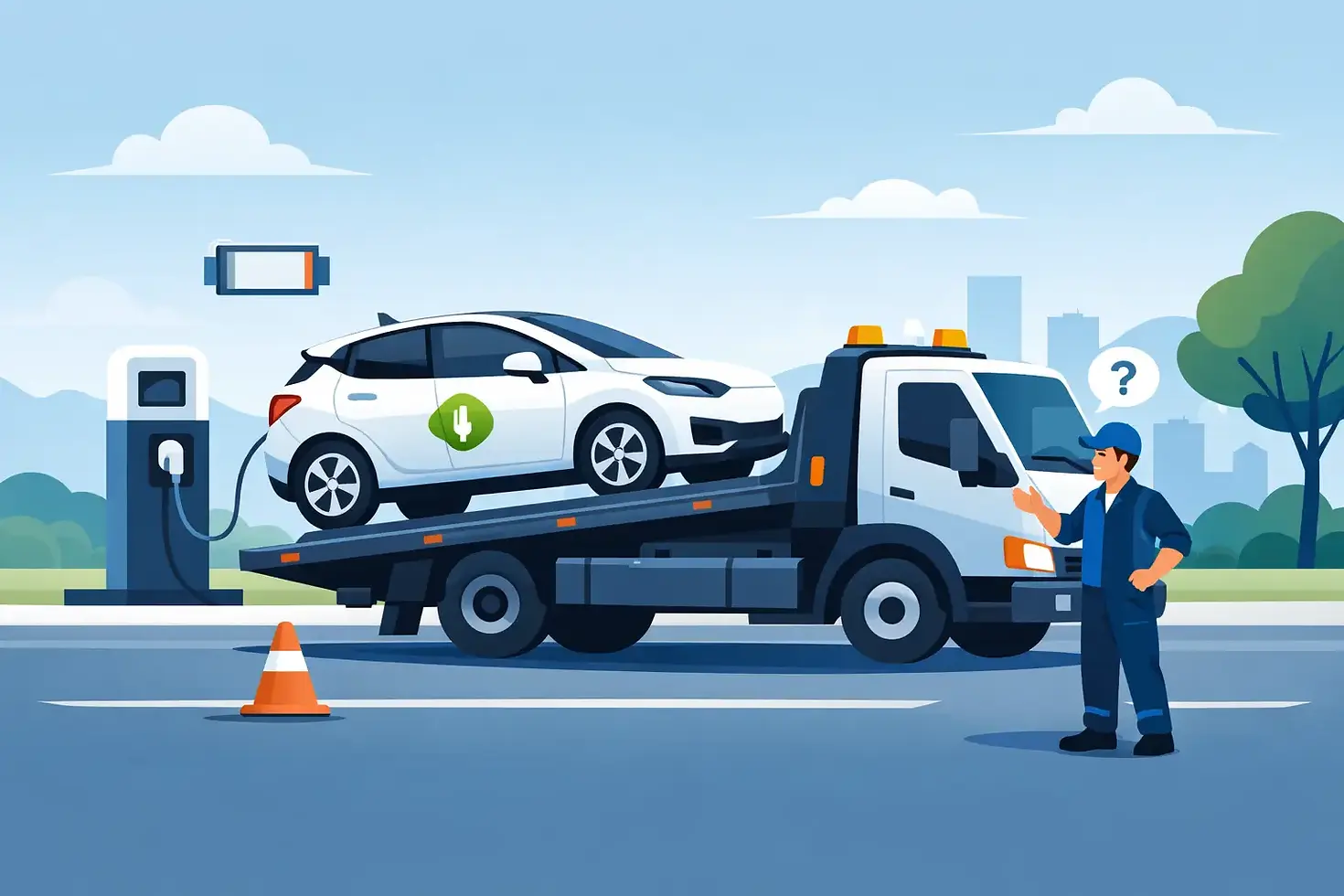
EV Out of Charge Towing: What to Do
You pull into a charger with 2 percent left, only to find it offline or already in use. That is usually how an EV roadside call starts. When you need ev out of charge towing, the right response matters because an electric vehicle cannot always be handled the same way as a gas-powered car.
For drivers across Vancouver Island, the problem is not just running out of battery. It is where it happens, how far you are from a working charger, and whether the tow operator understands EV recovery. A low or empty high-voltage battery can leave you stranded in a driveway, on a rural road, at a trailhead, or on the shoulder near town. In each case, safety and proper towing method come first.
When EV out of charge towing is the right call
A lot of drivers ask whether they should try to stretch the last few kilometres, restart the vehicle, or wait and see if the battery reading changes. In most cases, once the vehicle has gone into turtle mode, reduced power mode, or fully shut down, it is better to stop trying to force movement and arrange help.
Unlike a gas vehicle, you cannot solve the problem with a jerry can. If there is no practical way to charge on site, towing is usually the fastest and safest option. That is especially true if you are stopped in traffic, parked somewhere without charger access, or dealing with poor weather after dark.
There are also cases where the battery is not actually at zero, but the car will not drive safely enough to reach the next charger. Cold temperatures, steep grades, towing a trailer, strong headwinds, and battery age can all cut real-world range. A driver may think there is enough charge left, then find the estimate dropping much faster than expected.
Why EVs need a different towing approach
This is the part many drivers do not think about until they are already stranded. Some electric vehicles should not be towed with the drive wheels on the ground, because the motor and drivetrain can be damaged when the wheels spin without the system operating as designed.
That is why a flatbed is often the preferred option for ev out of charge towing. It keeps all four wheels off the road and reduces the risk of damage during transport. It also helps when the vehicle is completely disabled and cannot be shifted or moved normally.
There are exceptions depending on the make, model, and manufacturer instructions. Some vehicles have tow modes or specific recovery procedures. Others need dollies or a careful winch setup before loading. The safe answer is not to guess. The towing method should match the vehicle.
What to do while you wait for a tow
If your EV is out of charge, your first job is to make the scene safe. Pull over as far as possible if the vehicle still has enough power to coast into a safer spot. Turn on your hazard lights if they still work. If you are on a busy road, stay well clear of traffic and follow normal roadside safety steps.
Then gather the details a tow company will need. Your exact location matters, especially on Vancouver Island where service calls may be on highways, back roads, ferry approaches, campgrounds, or rural properties. The vehicle make and model matter too, because EV towing procedures vary.
It also helps to mention whether the car is fully dead, stuck in park, showing warning messages, or located in a tight space like a condo parkade or narrow driveway. That information helps dispatch send the right truck and equipment the first time.
If the vehicle is in an unsafe location, say that right away. A car stopped in a live lane or narrow shoulder needs a faster and more controlled roadside response than one sitting safely in a parking lot.
The most common causes of an EV running out of charge
Sometimes the reason is simple. The driver misjudged the distance to the next charger, or the battery was lower than expected when the trip started. But many out-of-range calls happen because several small factors stack up at once.
Cold weather is a big one. Cabin heat, battery conditioning, and reduced battery efficiency can all cut range. Highway speeds do the same. So does climbing elevation, carrying extra cargo, or pulling a trailer. On Vancouver Island, even a well-planned route can change quickly if a charging stop is unavailable or there is a detour.
Charging access is another factor. A charger may be occupied, out of service, incompatible, or slower than expected. Drivers who rely on one planned stop without a backup can run into trouble fast. This is especially true in less densely serviced areas or during peak travel times.
Where should the vehicle be towed?
That depends on the situation. If the nearest suitable charger is close and the vehicle has no other fault, towing to a charging location may be enough. That is often the quickest solution when the issue is simply an empty battery.
But it is not always the best choice. If the vehicle shows error messages, has a 12-volt issue, suffered impact damage, or shut down unexpectedly with charge still showing, it may need more than a charging stop. In that case, towing to a repair facility makes more sense.
This is where using one provider for both roadside help and follow-up service can save time. A local company with towing and automotive repair support can help move the vehicle and address related issues instead of leaving the driver to arrange the next step separately.
EV out of charge towing on Vancouver Island comes with local realities
Vancouver Island driving is not the same as driving in a major urban core with chargers on every few blocks. Distances between communities, weather shifts, limited late-night charging options, and rural travel all affect how an EV range problem plays out.
A driver in Parksville or Nanaimo may have more nearby options than someone stranded outside Coombs, Bowser, Port Alberni, or farther north. In some areas, mobile signal can also be spotty, which makes planning ahead more important.
That is why local coverage matters. A towing company that already serves the region understands the routes, common problem spots, and practical realities of getting a disabled EV off the road safely. All Island Towing & Automotive Repairs handles this kind of call with the same practical approach used for any urgent roadside issue - send the right equipment, move the vehicle safely, and help the driver get to the next step.
How to reduce the chance of needing this service
No one can remove the risk completely, but a few habits make a real difference. The first is to leave more buffer than the dashboard estimate suggests, especially in winter or on longer highway trips. A battery estimate is not a promise. It changes with speed, terrain, weather, and load.
The second is to avoid planning your trip around a single charging stop if the battery is already low. Check whether there is another workable option nearby. If your route includes remote stretches, assume charging may take longer or be less predictable than you hope.
It also helps to keep your vehicle software updated and understand how your model handles low-charge warnings. Some EVs give more useful notice than others. Knowing when reduced power mode starts and what it feels like can help you decide to stop before the situation gets worse.
If you tow a trailer, carry heavy gear, or make frequent longer drives, build that into your charge planning from the start. Real-world use matters more than brochure range.
Choosing the right towing help for an electric vehicle
Not every tow call is complicated, but EVs do require attention to detail. When you call for help, you want a provider that understands proper loading, transport, and the need to protect the vehicle from avoidable damage.
Fast response still matters, of course, but speed alone is not enough. The right tow for an electric vehicle is one that arrives prepared, uses the correct equipment, and takes the vehicle where it actually needs to go, whether that is a charger, your home, or a repair shop.
If your EV runs out of charge, the best next move is not to guess or push your luck for another few kilometres. Stop safely, call for proper assistance, and let the vehicle be handled the right way. A short tow done properly is usually the simplest path back on the road.


Comments